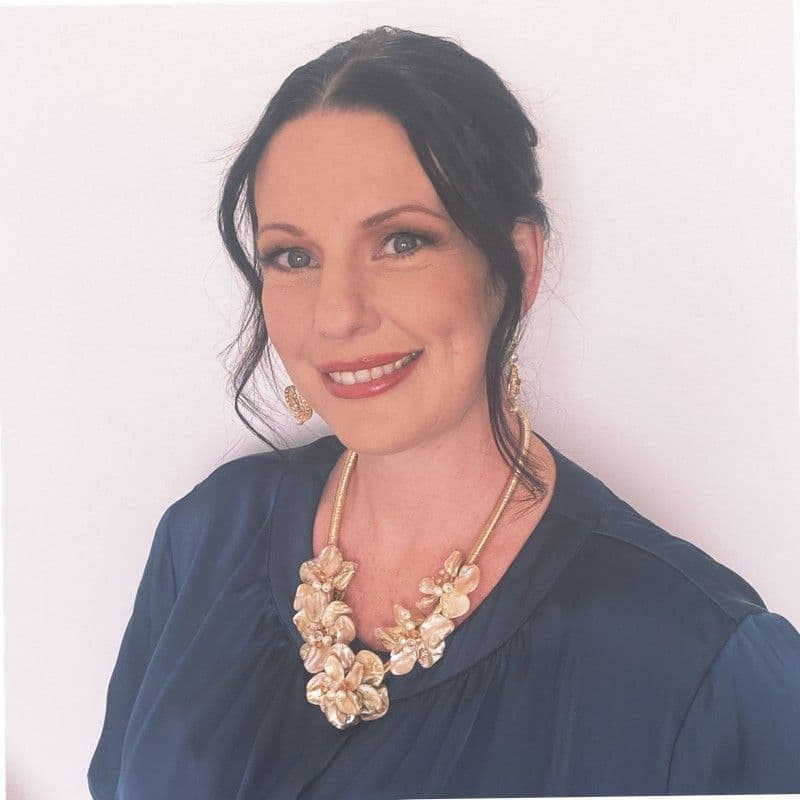
Jade Gulliver, Founder & Director of Heart Bridge Health
By a GP recruitment specialist

A GP marketplace built from inside an industry that needed a better way.

After a decade placing GPs across Australia, I kept asking the same question: why does it cost a clinic $20,000 to find one doctor — and who’s really paying that price?

Jade Gulliver

Jade Gulliver

Founder & Director

That $20,000 fee comes from somewhere.
01
The cycle

A system built on commission, not fit.

After nearly a decade inside the Australian GP recruitment industry, I’d watched the same cycle play out hundreds of times. A clinic needs a GP. They call an agency. The agency headhunts, vets, pushes paperwork, and delivers a shortlist — often with a commercial incentive toward whoever pays the most commission, not necessarily whoever is the best fit. The invoice arrives. $20,000 for a single doctor.

DoctorAgencyClinic$
The patient carries the weightof a system they never chose.
02
The cost

Someone always pays — and it’s not the agency.

That fee has to come from somewhere. Sometimes it’s the doctor, whose offer is quietly shaped by what the agency needs to earn. Sometimes it’s the clinic, cutting admin costs or consumables to stay afloat — and those cuts ripple outward.

At the end of that chain is a patient, whose favourite doctor moved on because the support wasn’t there. Or who turns up to find there’s no face mask available because the clinic can’t absorb another overhead.

“Clinics and GPs work incredibly hard to provide exceptional patient care. The fee itself isn’t the problem — it’s what the system underneath it costs everyone who never sees the invoice.”

— Jade Gulliver, Founder

The ripple effect on patients — and communities

GPs don’t make career decisions the way other professionals do. They have patients’ lives on their shoulders. One wrong placement — a clinic with misleading billing structures, inadequate admin support, or a culture that doesn’t allow quality care — can affect a doctor’s ability to practice. It can put their AHPRA registration at risk, drive up their indemnity insurance costs, or push them out of the workforce entirely.

In a country already facing a GP shortage, every doctor who leaves a role they weren’t properly informed about is a community left without care.

“I built Heart Bridge because that mattered to me — not just commercially, but personally.”

I found a way to make it make sense.

Every part of the agency fee exists for a reason — headhunting, vetting, paperwork, compliance, the pitch. Heart Bridge doesn’t pretend those needs don’t exist. It builds the tools to meet them directly, between the people who matter most.

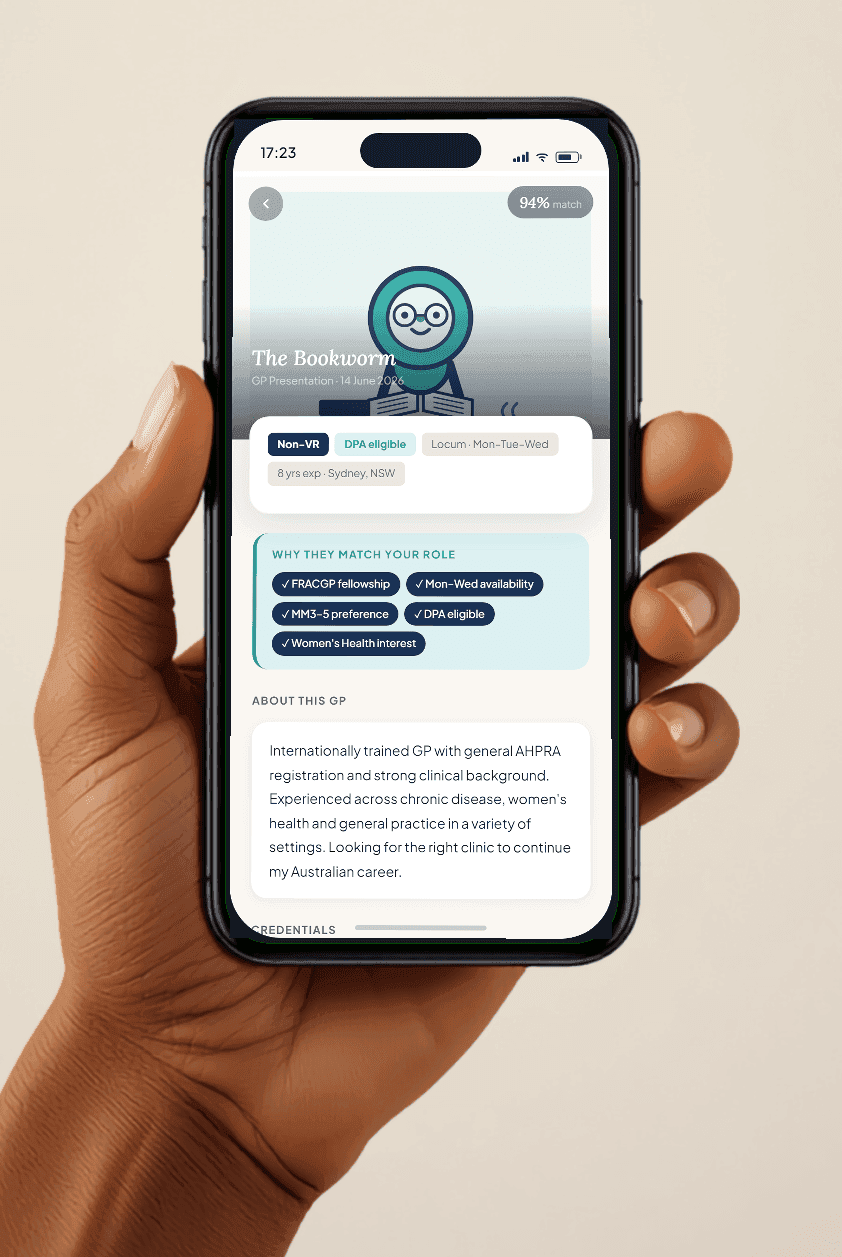
Smart matching — vetting built in

GPs only see opportunities they’re actually eligible for. DPA classifications, fellowship requirements, visa conditions — the platform does the filtering before anyone wastes time on a role that was never going to work.

Direct communication — no middleman

Clinics and GPs talk to each other from day one. No agency shaping expectations in either direction. What you say is what they hear — honest connections from the first message.
Lumi AI — compliance without the consultant

Lumi handles the complex questions — DPA compliance, Medicare billing rules, contractor terms, AHPRA pathways — 24/7. The guidance that used to require a phone call to an agency is now instant, accurate, and free.

Hearts rating — trust that goes both ways

Two-sided reviews after every placement. GPs know the clinic's culture before arrival. Clinics attract doctors who are genuinely interested, not just available. Reputation is portable and verified.

Jade Gulliver, Founder & Director of Heart Bridge Health

The founder

Jade Gulliver — Founder & Director, Heart Bridge Health

The problem I couldn’t stop seeing

I’ve watched a GP arrive from overseas to a clinic with not enough patients to fill their days — their visa tied to a clinic that wasn’t what they were sold. I’ve watched a clinic owner sign a $20,000 placement invoice for a doctor who quit after six weeks — and then do it again, because no one gave them a better option. I’ve had a doctor cry in my car after a placement fell apart, saying she just wanted someone to help her find somewhere she actually belonged.

I spent a decade inside GP recruitment — MedRecruit, Healius, ForHealth, Ochre Health, and others — placing hundreds of GPs across Australia’s most competitive markets. I know the compliance frameworks, the visa pathways, the billing structures, the fellowship requirements. I know what makes a placement succeed. And I know exactly what keeps breaking it.

The agency model isn’t broken because the people in it don’t care. It’s broken because the structure removes the two people who matter most — the doctor and the clinic — from the conversation until it’s too late to ask the questions that actually count. The agency brokers trust they’ve never personally earned, between people they’ve never worked alongside.

I built Heart Bridge because I couldn’t keep watching that happen.

“She just wanted someone to help her find somewhere she actually belonged.”

Where the instinct came from

At twenty, I moved to China alone — before smartphones, before I spoke a word of Mandarin — and spent four years teaching English in classrooms where trust had to be built without shared language. What I didn’t expect was how fast my own reputation would travel. Students I’d never met already knew whether I was worth trusting before I opened my mouth — because the ones who came before them told them. Not a brochure. Not a credential. A person, telling another person, the truth about what it was actually like to be in my classroom.

I’ve watched that exact dynamic play out across GP land my entire career. Doctors don’t ask agencies which clinic to choose. They trust the doctor in the next suburb who mentioned how great this clinic is. Clinics don’t trust a recruiter’s pitch — they ask the GP who worked with this GP last year how they were actually treated. Reputation travels through people who have no reason to lie, and it travels fast. That’s the entire principle behind Heart Bridge’s Hearts rating system — visible, verified trust built by the people who were actually in the room.

Because here’s what I learned in China, and what I’ve seen proven true in every placement since: knowing enough about where you’re walking into — the culture, the manager, the feel of the place — before you ever set foot inside changes everything. It’s the difference between arriving with confidence and arriving with dread. Agencies hand you a job description. They are not there on your first day.

That gap doesn’t just affect IMG doctors, though their experience is its own kind of courage — landing in Australia with a medical degree, a family left behind, and a stack of paperwork nobody explained, hoping the system meets them where they are.

It’s a feeling I know from the inside. I lived displacement myself in China — the particular disorientation of existing somewhere that doesn’t quite have a place for you yet. Years later, I recognised that same look in the foster children I cared for, kids trying to make sense of a home that was meant to be safe but still felt foreign. I saw it again when I volunteered helping refugees find their footing in Australia — people who had survived everything, but still had to learn how to belong. Displacement wears different clothes each time: a visa, a court order, a one-way flight, a child’s suitcase. But underneath, it always asks the same quiet question — will anyone help me find my place here?

That question never really left me. It just changed rooms when I moved into GP recruitment. Because moving clinics, more often than people admit, asks the same thing. New culture. New rhythms. New unwritten rules. The distance might be twelve thousand kilometres or twelve suburbs — the feeling of arriving somewhere and hoping it will hold you is the same either way. I built Heart Bridge because I’ve sat across the table from that feeling in almost every form it takes, and I got tired of watching people navigate it alone.

“The displacement is real whether the distance is twelve thousand kilometres or twelve suburbs.”

The precision behind it

Understanding the problem deeply wasn’t enough. I also had to learn how to actually close the gap — and that required two more decades of deliberate work in communication.

I trained in ethical sales framing with Mary Gober International. I completed SWISH Sales Coaching — the program featured on Shark Tank, backed by Dr Glen Richards, Steve Baxter, and Andrew Banks, who each delivered training in person. I studied body language and non-verbal communication through The Lens Program with Scott Taylor. And I trained in precision communication with James Pile — a retired U.S. Army interrogator turned consultant — where the entire focus was getting to the truth faster, with fewer words.

What those programs collectively taught me is that most breakdowns — in placements, in negotiations, in any high-stakes relationship — aren’t caused by a lack of information. They happen because the wrong person is doing the translating. When an intermediary sits between two people who need to understand each other, nuance dies in transit. The clinic’s real culture doesn’t survive the recruiter’s sales call. The doctor’s concerns rarely reach the practice manager. Both sides make decisions based on a version of each other that was filtered through someone with a fee to protect.

That insight is the backbone of everything inside Heart Bridge. The matching flows are designed to surface what actually matters to each party — not what looks good in a profile. And Lumi AI was built to ask the questions an experienced recruiter would ask — without the recruiter standing between the answer and the person who needs to hear it. The goal was never to automate recruitment. It was to remove the layer that was distorting it.

Megan Darby, Rural Partnerships Lead at Heart Bridge Health
Meet the team

Where Heart Bridge meets rural Australia.

Megan Darby — Rural Partnerships Lead

Megan has stood in rural towns when the doctor couldn’t be found. Not as a statistic in a workforce report — as the person watching it happen. The patients who stop coming because the clinic keeps closing. The families driving four hours for an appointment that used to be ten minutes down the road. The elderly who simply give up asking. Rural healthcare isn’t an abstract policy issue to her. It’s the people she’s worked alongside for over a decade — and it’s the reason she’s here.

A career on the floor

She’s seen the system from almost every chair in the building. Pathology. The specimen lab. The morgue. Nursing. Paramedicine. Emergency ward administration. All of it built in regional settings, where one understaffed roster doesn’t just slow things down — it breaks the chain of care for an entire community. When Megan talks about the operational, clinical, and workforce challenges facing rural clinics and hospitals, she isn’t theorising. She’s been the one on the floor at 2am.

Why it matters here

That experience shapes how she thinks about every part of Heart Bridge. Connecting clinics to GPs directly — without an agency taking a $20,000 cut — doesn’t just save money on paper. It’s the difference between a clinic that can afford a new ECG machine and one that can’t. Between a community that gets a specialist outreach service and one that doesn’t. Between a patient who travels 600 kilometres for a consult and one who walks down the street to see a GP who knows their name.

Fifteen years of frontline teaching

She also brings 15 years of frontline teaching with her. As the founder of 1st Aid M.D., Megan has trained thousands of educators, carers, parents, and businesses in first aid, infant and child resuscitation, and Cert IV mental health response. She’s particularly known for high-performance CPR — for making sure people aren’t just trained, but capable and confident to act when it counts. It’s the same principle behind everything she touches at Heart Bridge: knowing the answer isn’t enough. People need the structure to actually use it.

“I’ve watched what it does to a town when they can’t keep a doctor. That’s not a workforce problem — that’s a community holding its breath.”

— Megan Darby
Heart Bridge Academy

The marketplace connects you. The courses arm you.

Heart Bridge gives clinics and GPs the platform to find each other directly. But the playbook agencies use to headhunt, vet, and close — the one they charge $20,000 to run — shouldn’t be locked behind a fee. I’ve distilled nearly a decade of recruitment frameworks, IMG pathway knowledge, and contract negotiation strategy into practical, self-paced courses. The same systems. A fraction of the cost.

For clinics

How to Attract & Convert the Right GP

The complete recruitment system — build compelling offers, understand billing splits, and convert candidates without ever paying an agency.

$499

For compliance

IMG Pathways — EAP, PEP & FSP

Step-by-step guides to every IMG credentialing pathway — supervision requirements, paperwork, timelines, and how to use each as a retention strategy.

From $197

For GPs & IMGs

How to Negotiate Your GP Contract

Understand billing splits, guaranteed minimums, locum rates, restraint clauses, and benefits packages — negotiate from knowledge, not guesswork.

$399

Jade Gulliver

I built this for the GPs and clinics who deserve better.

We’re onboarding clinics and GPs now for a May 2026 launch. Join the waitlist — it’s free, and you’ll be first in.

Free for GPs, forever.

Questions? team@heartbridgehealth.com.au